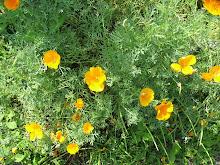
Some of the other perennials in bloom include pulmonaria, lemon balm, and pachysandra, and the hostas, ferns, and lily of the valley are poking out of the ground and starting to unfurl their leaves. After all of the dreary weather and flooding of the early spring, it's nice to see them return. It's too early to tell which diseases or pests will surface from this disruption from the norm, though I've heard we may be visited by an overabundance of winter moths.
Showing posts with label garden pests. Show all posts
Saturday, April 24, 2010
Now in bloom at home
Some of the other perennials in bloom include pulmonaria, lemon balm, and pachysandra, and the hostas, ferns, and lily of the valley are poking out of the ground and starting to unfurl their leaves. After all of the dreary weather and flooding of the early spring, it's nice to see them return. It's too early to tell which diseases or pests will surface from this disruption from the norm, though I've heard we may be visited by an overabundance of winter moths.
Monday, September 21, 2009
Monday harvest post - vegetable medley for one
1/3 pound (estimated) of green beans at $0.99/lb.: $0.33
1 pound of organically grown tomatoes at $3/lb.: $3.00
New benefits total: $127.05
Current costs total: $171.57
New balance: - $44.52
It's been hard to believe given the last week or so of really pleasant, seasonable weather that I wouldn't have a tomato harvest that would put me in the black. Sigh...
Labels:
broccoli,
garden pests,
pole beans,
raspberries,
tomatoes,
value of harvest
Sunday, June 7, 2009
Update on my plot
The advantage of the medium of blogging is the ability to bypass the editorial process and post news as it happens. However, today I find myself breaking this important rule to present you with photos taken three days ago (the horror!) and report on Thursday's and Saturday's MSG visits. Imagine if the Boston Globe waited until today to report an incident that occurred on Friday? Luckily, My Dirt is unhampered by the pressures to keep current or suffer from more financial consequences; when you have no budget, you have no budget to lose.
So with this in mind I'll keep to the business of earning through my harvest, which is now picking up, and I'll update you on the estimated value of my yield sometime this week. In the meantime, here's a photo of the first June-bearing strawberries, picked from my plot on Thursday. When I returned yesterday I filled a recycled pint container with more and picked four small heads of Romaine lettuce. I was rushing around on errands yesterday in preparation for company last night, so no time to take out the camera.
The leaf miner on my spinach had reappeared on most of the few leaves I had left remaining, so I pulled out all but my two healthiest plants. But my biggest concern was that a few of the lower leaves of my broccoli plants were showing a similar blight. On Thursday, I pulled off those leaves and took this photo of one of my plants out of concern for a few holes in the upper leaves. Luckily, there were no new signs of the blight yesterday, and, surveying the broccoli in other plots, I have come to believe that the holes are not necessarily a sign of danger (alternative interpretations are always welcome!).
In the flower department, I planted zinnia seeds in a new location, because I needed last year's space to start some Kentucky Wonder pole beans. Better late than never, I guess. No worries with the California poppies, however, they self-seed every year, and have been in bloom for the past week or so. One of the coolest features of this annual is the contrast between the papery bright-orange fully-opened flower and the way it looks closed, a delicate light-green cone served on a bubble-gum pink plate. As for my perennials, I can see the white beginnings of buds on my blanket flowers, the plants' eggplant-colored leaves can be seen in the right rear of the poppy photo.
I will finish this post now so I can take advantage of the glorious weather we are having; it would be sacrilegious to squander this opportunity by spending it in front of a screen. I'll leave you with my garden envy photo for this post: some irises from another MSG plot. I had never seen irises of this color, sort of a combination of sepia and pink.
Labels:
annuals,
blogging,
broccoli,
garden pests,
perennials,
strawberries,
zinnias
Wednesday, May 27, 2009
The benefits of gardening and other updates
Some of you may recall that I started my 2009 gardening season with an experiment recording my gardening expenses and comparing them to the estimated costs of the vegetables and fruits that my gardens would yield. My not-so-scientific process began with a general question: Does gardening save money on food costs, and if so, by how much? However, I plowed right into my research with no hypothesis, and three months into the procedure, I am still on the fence, partly due to the amount I have spent so far on a new grow light, salt hay, plot dues, and other expenses.
Since then, a few weeks have passed without a cent going directly into my gardening costs. But now, I can begin estimating my yield. In recent posts I've reported that my family and I have already started enjoying some of the lettuce and spinach. What we began eating every few days has now become what rice is to many other cultures. Now salads must be consumed every day, and no sandwich is permitted to be made without a layer of green. Anyone who walks in the door of our home will not be allowed out without a recycled takeout container of the most recent harvest.
But before I continue on this subject, I'd like to ask: What has happened to some of my spinach? I returned to the Minton Stable Garden yesterday after a few days away to find an ugly blight. Some of the leaves appeared bleached out, while others displayed what looked like bird droppings. I doubt that a flock of birds would hover over a row of spinach and leave the rest of the garden untouched. My husband's theory based on his past experience (although he's away for work and unable to see the problem, let alone meet his salad quota) is that it may be a fungus. From a search through my books and the Internet I learned that too much moisture lingering on spinach leaves can lead to diseases such as Anthracnose (which comes closest to resembling what mine have) and the more threatening-looking blue mold. The rainy, chilly weather of the past few days may be to blame. I bagged up the affected leaves and discarded them. End of story, I hope.
Now, back to the healthy greens harvested--how much are they worth? Since I've been picking leaves and not whole heads or bunches, I'll base my estimation on my experience buying a similar organic product. At this point my daughter and I have picked the equivalent of one container of Olivia's Organics salad mix, perhaps a combination of their Romaine and Spinach products, or another mix. I believe that the last time I saw it at the Harvest Coop in JP it was priced at $3.59 a container, so I'll make the not-so-scientific assumption that I have saved that much in my food budget. So my total monetary benefit of my vegetable and fruit gardening is so far:
1 container* of salad greens $3.59**
*According to the web site, the size is 6/5 ounces.
**In Massachusetts, food from the grocery is not taxed.
I have never been good at making quick decisions, but I had promised myself that by the end of the post I would be able to jump off the fence in one direction or the other. Will the value of my harvest exceed my expenses? My guess is now...maybe next year.
As I finish this up it has begun to rain again in Boston. You might find me in the MSG tomorrow wiping off my spinach. In the meantime, I'll leave you with an image of what's coming into bloom: lupines and poppies from another gardener's plot.
Since then, a few weeks have passed without a cent going directly into my gardening costs. But now, I can begin estimating my yield. In recent posts I've reported that my family and I have already started enjoying some of the lettuce and spinach. What we began eating every few days has now become what rice is to many other cultures. Now salads must be consumed every day, and no sandwich is permitted to be made without a layer of green. Anyone who walks in the door of our home will not be allowed out without a recycled takeout container of the most recent harvest.
Now, back to the healthy greens harvested--how much are they worth? Since I've been picking leaves and not whole heads or bunches, I'll base my estimation on my experience buying a similar organic product. At this point my daughter and I have picked the equivalent of one container of Olivia's Organics salad mix, perhaps a combination of their Romaine and Spinach products, or another mix. I believe that the last time I saw it at the Harvest Coop in JP it was priced at $3.59 a container, so I'll make the not-so-scientific assumption that I have saved that much in my food budget. So my total monetary benefit of my vegetable and fruit gardening is so far:
1 container* of salad greens $3.59**
*According to the web site, the size is 6/5 ounces.
**In Massachusetts, food from the grocery is not taxed.
As I finish this up it has begun to rain again in Boston. You might find me in the MSG tomorrow wiping off my spinach. In the meantime, I'll leave you with an image of what's coming into bloom: lupines and poppies from another gardener's plot.
Labels:
expenses,
garden pests,
lettuce,
rain,
value of harvest
Monday, December 1, 2008
Bedtime
Most people appeared to have pulled out their plants and dug up the soil. A few people covered their plots with salt hay. I wondered where they were able to procure this useful material that I had searched for earlier this season. In any case, it blows my mind to think that just two months before, you couldn't walk through these plots without becoming tangled in greenery.
Tuesday, October 28, 2008
Smart, but not smart enough
"It's called smartweed," John Carroll told me one day while I was helping him maintain one of the flower beds he had planted in the old Minton Stable Garden. It earned that name, he explained, because it is smart enough to take on the appearance of a flower that one might grow on purpose. With its greenish-pink brush-like flowers and long tapered leaves, it does seem too attractive to pull, especially when it adds some color to a fading fall garden.
But don't be fooled. It may not strangle plant stems like bindweed does, but smartweed can still be invasive. Known by its scientific name of polygonum hydropiper, there are two main types of smartweed: aquatic and terrestrial. I've been encountering the terrestrial smartweed not only in my MSG plot, but also in my gardens at home, as you can see in a neglected flower bed next to my house (perhaps posting this photo will shame me into leaving my perch at the Ula Cafe to go home and weed, now that the rain has cleared).
I could place a plastic bag over the smartweed before pulling it; that would greatly reduce the possible spreading of some of the 3000 seeds or more that the plant produces. But I could also harvest it for medicinal purposes, to treat a variety of illnesses from common colds to cholera.
I doubt that I will take either of these measures. As I do every year, I'll just pull the smartweed out by the roots and admire its pretty pink flowers as I chuck them in with the other yard waste.
Saturday, September 13, 2008
Return of the Raspberries
Today's community garden work day was productive. Having glanced at the sign-in sheet, it appeared that at least 20 gardeners and wannabe gardeners showed up. Having gotten to know several people in the latter group over the summer, I hope that they'll get off the waiting list soon. Then next spring they can get their hands dirty on a more regular basis and channel some of that community involvement they have displayed into a rewarding gardening experience. And we'll see them more often.
Usually we spend our work days pulling plants out of the ground. There was still a bit of that to be done today. I was assigned the task of pulling out whatever burdock I could find in the common areas. I did my best to dislodge the noxious weed's stubborn roots, but I cannot claim victory. I wouldn't be surprised if we had to repeat this task at the October work day.
However, most of the participants were busy putting plants in the ground, including asters and goldenrod, native plants that are coming into their peak of beauty at this time of year. But the initiative that is exciting me the most involves something sweeter.
Not far from the original patch, a new area (see photo) was dug up today and fortified with compost. Gardeners will be urged to dig up and plant their excess raspberry bushes in the new plot so everyone can enjoy them for years to come. I wish I had some plants to divide! But I'm looking forward to the return of this MSG feature.
Tuesday, July 8, 2008
Bindweed battles
The garden has always had its pests, animal or vegetable. It's been years since I've heard about the Mexican bean beetle, yet I still haven't recovered enough to resume growing one of my favorite vegetables. And one need not go far to find some crown vetch choking some wildflowers in one of the common areas.
This year, the garden's equivalent to the bird flu has been an innocent-looking perennial weed known as field bindweed, or by its scientific name, convolvulus arvensis. We have been advised by the Steering Committee in a recent email to "keep an eye out and dispose of it properly." Bindweed has been discovered in a few plots and will proliferate rapidly if not dealt with in a timely manner.
About a week ago, before reading the email, the skies were finally cleared from our "mini-monsoon season." I ventured over to my plot, bracing myself for what I might find around my tomatoes and peppers, which I still had not gotten around to mulching. I encountered an explosion of one type of weed in particular, so hardy it even grew under the shade of my plot-neighbor's massive squash leaves. Though I discovered that one of the compost receptacles had been quarantined because a gardener accidentally threw some bindweed in with other plant matter, I went about my usual business, filling a wheelbarrow with extraneous plant matter from my plot and dumping it in the other compost pile.
I had always thought bindweed was the vine I had growing in my own yard, which had darker and shinier petal-shaped green leaves growing straight up on a single stem. Then I read the email, and when I opened the link to the University of California Agriculture and Natural Resources site showing photos of our resident scourge, I felt a rise in my body temperature and a wave of nausea. Were the weeds I had composted the same as the bindweed seedlings shown, with its spade- or bell-shaped leaves? Had I committed germ warfare?
To be continued...
Subscribe to:
Posts (Atom)