So with this in mind I'll keep to the business of earning through my harvest, which is now picking up, and I'll update you on the estimated value of my yield sometime this week. In the meantime, here's a photo of the first June-bearing strawberries, picked from my plot on Thursday. When I returned yesterday I filled a recycled pint container with more and picked four small heads of Romaine lettuce. I was rushing around on errands yesterday in preparation for company last night, so no time to take out the camera.
 The leaf miner on my spinach had reappeared on most of the few leaves I had left remaining, so I pulled out all but my two healthiest plants. But my biggest concern was that a few of the lower leaves of my broccoli plants were showing a similar blight. On Thursday, I pulled off those leaves and took this photo of one of my plants out of concern for a few holes in the upper leaves. Luckily, there were no new signs of the blight yesterday, and, surveying the broccoli in other plots, I have come to believe that the holes are not necessarily a sign of danger (alternative interpretations are always welcome!).
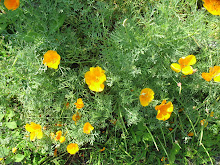
 In the flower department, I planted zinnia seeds in a new location, because I needed last year's space to start some Kentucky Wonder pole beans. Better late than never, I guess. No worries with the California poppies, however, they self-seed every year, and have been in bloom for the past week or so. One of the coolest features of this annual is the contrast between the papery bright-orange fully-opened flower and the way it looks closed, a delicate light-green cone served on a bubble-gum pink plate. As for my perennials, I can see the white beginnings of buds on my blanket flowers, the plants' eggplant-colored leaves can be seen in the right rear of the poppy photo.
I will finish this post now so I can take advantage of the glorious weather we are having; it would be sacrilegious to squander this opportunity by spending it in front of a screen. I'll leave you with my garden envy photo for this post: some irises from another MSG plot. I had never seen irises of this color, sort of a combination of sepia and pink.